AZINCOURT
Bernard Cornwell
Azincourt (or Agincourt) is apparently one of the most famous battles in English history, but having no knowledge of the pre-Tudor era I had no idea what to expect. Yet Bernard Cornwell tells us about the famous battle only in the last 1/3 of the novel, instead focusing on the story of English archer Nicholas Hook and how he came to be part of la malheureuse journee ("the unfortunate day") for France on Saint Crispin's Day, 25 October 1415.
Cornwell has Hook hearing the
voices of Saint Crispin and Saint Crispinian and guiding him, but I think this was underutilized in the development of his character. I felt no connection with him or any of the characters in the novel because despite the horrors they experienced, they still lacked depth.
Cornwell's descriptions of the siege of the port town of Harfleur and the Battle of Azincourt that followed were well-written. I never realized the strength and the importance of archers in battle. To give one an idea why Azincourt became legendary, here is an illustration of the battlefield (from The New York Times) -
However, I would have appreciated more information about the history of the enmity between England and France, and about the king who brought the Englishmen and Welshmen to war, Henry V.
Rating:
"THE SUNNE IN SPLENDOUR"
Sharon Kay Penman
News of the discovery of Richard III's remains under a car park in Leicester, England prompted me to finally read this hefty novel.
Richard III is infamous as the king who had his brother Edward IV's son and successor Edward V and other son Richard, popularly known as the Princes in the Tower, killed while imprisoned in the Tower of London. He is the last king of England to have died in battle, in Bosworth Field in 1485, and the last Plantagenet king, after which the Tudor dynasty reigned.
I first read about Richard III in "The Daughter of Time" by Josephine Tey about 5 years ago, and was intrigued by the
story of Richard and his nephews. Did he, or did he not, order their
murder?
In this novel, as in "The Daughter of Time", the author tries to make a case for Richard III. She chronicles his life and the life of his brother Edward IV, that of their family the House of York, and of their friends and supporters during the Wars of the Roses. Penman also shows us the other side of the coin, the House of Lancaster of Henry VI.
My thought throughout the novel was, "George R.R. Martin's A Song of Ice and Fire has nothing to this!" It really happened; rebellions and factions and betrayals... I wonder if the Wars of the Roses inspired GRRM. Like ASoIaF, it was difficult to keep track of the characters at first, all the Edwards and Richards and Henrys and Elizabeths and Annes, that I had to look for a family tree online.
Having no previous knowledge of English history and not having read the play by William Shakespeare, my sympathy lies with Richard III. But I admit that these historical novels were written against popular belief, so I aim to read a non-fiction account, "The Princes in the Tower" by Alison Weir, in future.
For now, I remain loyal to the Whyte Boar of Gloucester.
Rating:
BLACKOUT & ALL CLEAR
Connie Willis
The latest addition to Connie Willis' Oxford Time Travel series, which includes "Doomsday Book" and "To Say Nothing of the Dog", "Blackout" and "All Clear" document the stories of historians Polly Churchill, Merope Ward, and Michael Davies. Polly, Merope, and Michael each travel back in time from Oxford in the year 2060 to different periods of World War II Britain to do research, but their lives intertwine when their means of returning to the future does not work, and they are stuck in the past trying to find a way back.
At a total of almost 1,200 pages, not a few readers have found the two novels too lengthy. Indeed, the story was intended to be one novel that was eventually split into two volumes. This means that before starting on "Blackout", one must be prepared to read "All Clear" afterwards, to be able to appreciate the story fully. The fact that the novels jump from one character to another and from one time period to the next also adds to the challenge.
Instead of bogging down the story, I think the novels are richer for the wealth of information they impart about the daily lives of ordinary people in wartime England. This is especially true for people like me whose education, by virtue of place of residence, focused on the Pacific Theater of the Second World War. Part of the appeal of the novels for me too, is trying to figure out the connections between the people who enter the lives of Polly and Merope and Michael, and the events that surround them. The story would be different, I think, were such details left out.
A good story for me is one which has characters who stay with me even after I've closed the book, and one that makes me think; in this case, about the complexities and paradoxes of time travel, which I will leave to readers brave enough and patient enough to tackle the novels, to figure out (to avoid spoilers). More than the above, "Blackout" and "All Clear" are Connie Willis' love letters to the men and women who lived and survived World War II; the soldiers who fought the war, and the loved ones they left behind.
Rating:
Being a fan of history books, non-fiction and fiction alike, I checked out The Guardian's Top 10 Best Historical Novels, and was struck by the phrases "the destruction of the church of Les Innocents and the clearance of its cemetery" and "major conflicts... between history and progress, remembering and forgetting". It was part of the list-compiler's description of "Pure" by Andrew Miller, winner of the 2011 Costa Book Awards.
I was intrigued, and read more. And learned that his first novel, "Ingenious Pain", whose main character reminds me of Jean-Baptiste Grenouille from "Perfume" by Patrick Suskind, won several awards.
Also, Andrew Miller is hot (for a 52-year-old)!
How could I have not heard of him before? Well, the only thing to do is
to rectify the situation and get my hands on the above books.
THE GUERNSEY LITERARY AND POTATO PEEL PIE SOCIETY
Mary Ann Shaffer and Annie Barrows
 I have seen this novel a couple of times at my favorite secondhand
bookstore, but what finally made me buy a copy were the recommendations
from members of The Historical Fiction Group at Shelfari.
I have seen this novel a couple of times at my favorite secondhand
bookstore, but what finally made me buy a copy were the recommendations
from members of The Historical Fiction Group at Shelfari.
Trying
to rebuild their lives after the Second World War, writer Juliet Ashton
receives a letter from farmer Dawsey Adams, who lives on the island of
Guernsey in the English Channel, asking her to recommend a book seller
who would send him Charles Lamb's works. Thus begins the correspondence
between Juliet and the other members of The Guernsey Literary and Potato
Peel Society, and other characters that inhabit Juliet's life in London
and Dawsey's life in Guernsey.
I finished the book in an
afternoon, stopping near the end for a cup of tea and a tuna sandwich (I
dislike cucumbers) to savor the book longer. I was charmed by Guernsey
and its people. Each character's personality comes across in the letters
he or she writes, making me mourn the disappearing art of
letter-writing in this age of the internet. I especially empathize with
Juliet, who at the age of 32 has mostly resigned herself to living a
solitary life with her writing and her books, breaking off her
engagement with a man who would dare empty her bookshelves and pack her
books in boxes.
The story wanders, although Juliet remains the
center, but that's how life happens; one can't impose order on it.
Still, the novel affirms the fact that sometimes it is not the book that
matters, but the company of people who enjoy books and reading as much
as one does.
Rating:
LINCOLN'S DREAMS
Connie Willis
 While doing research on Abraham Lincoln and his prophetic dreams, Jeff
meets Annie, herself experiencing the Civil War in sleep, and tries to
help her find meaning to her dreams.
While doing research on Abraham Lincoln and his prophetic dreams, Jeff
meets Annie, herself experiencing the Civil War in sleep, and tries to
help her find meaning to her dreams.
I know next to nothing about
the American Civil War, but it did not hinder me from enjoying Connie
Willis' "Lincoln's Dreams". Annie's experience was gripping, and the
story relevant.
We are conditioned to look up to our heroes on
their pedestals, but we need to remember that they were human too. Even
though they inspire us by their courage and with their triumphs, they
also suffered loss and failure.
Jeff, turning down a job
opportunity on studying the effects of the Vietnam War, says, "I haven't
figured out the long-term effects of the Civil War yet." It seems that
mankind has not even recovered from one war before he becomes involved
in another. In the last century alone, we had World War I, World War II,
Korea, Vietnam, and Iraq, with Afghanistan at the start of this
century. Does no one understand that war does not solve anything? It is a
waste of human lives and material resources. War does not resolve
conflict, it only postpones it until the "losing" side musters strength
to fight again. Which is a lesson mankind, sadly, seems slow to learn.
Rating:
PERFUME: The Story of a Murderer
Patrick Suskind
 Jean-Baptiste Grenouille was born with a gift – an extraordinary sense
of smell. This enables him to become the greatest, if unrecognized,
perfumer in eighteenth-century France. Yet Grenouille was born without a
smell of his own that would mark him as human. Thus he sought to create
the perfect scent that would make men and women fall on his feet and
worship him – a scent made from virgins on the brink of womanhood.
Jean-Baptiste Grenouille was born with a gift – an extraordinary sense
of smell. This enables him to become the greatest, if unrecognized,
perfumer in eighteenth-century France. Yet Grenouille was born without a
smell of his own that would mark him as human. Thus he sought to create
the perfect scent that would make men and women fall on his feet and
worship him – a scent made from virgins on the brink of womanhood.
Patrick
Suskind successfully evokes the atmosphere of eighteenth-century Paris
by describing the stench of its streets littered with refuse and the
odor of its thousands of humans living in close quarters, and he
contrasts these with fragrances from the city’s perfumeries that
intrigue the reader’s nose – roses and orange blossoms and jasmine and
storax… In the middle he places the young Grenouille, eager to
experience and catalog in his mind all smells, good and bad, in
existence.
Later Grenouille turns this passion into the creation
of the perfect scent, regardless of the means needed to achieve it. In
doing so he seeks affirmation of his identity and acceptance from the
people who in the past ignored him at best and used him for their own
ends at worst. He realizes, too late, that his hatred for the same
people has surpassed his need for their acceptance, and his success
becomes worthless.
Instead of hatred or revulsion, one feels pity
for Grenouille and the circumstances that shaped him into what he is.
And one is left with a question – Does the need to please the self
ultimately stem from the need to please others?
Rating:
POSSESSION
A.S. Byatt
 Roland Michell, a Randolph Henry Ash scholar, stumbles upon drafts of a
fervent letter by the 19th century poet to an unknown woman, soon
determined to be writer Christabel LaMotte, and embarks on a journey of
discovery with LaMotte scholar and relation Maud Bailey.
Roland Michell, a Randolph Henry Ash scholar, stumbles upon drafts of a
fervent letter by the 19th century poet to an unknown woman, soon
determined to be writer Christabel LaMotte, and embarks on a journey of
discovery with LaMotte scholar and relation Maud Bailey.
The
reader may find him- or herself intimidated by the seeming verbosity of
the novel, as I was when I first attempted to read it, but will soon be
caught up in the mystery of the Ash-LaMotte correspondence and the
beauty of A.S. Byatt’s words. I am especially impressed with the way she
has written in different, distinct voices – Randolph Henry Ash,
Christabel LaMotte, Blanche Glover, Ellen Ash, Sabine de Kercoz – in the
form of letters and poetry and journals.
Rating:
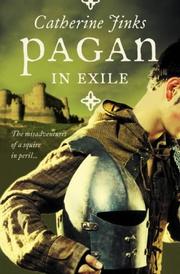
PAGAN IN EXILE
Catherine Jinks

"Pagan in Exile" is the second in a four-book series about Pagan
Kidrouk, a Christian Arab from Jerusalem who joins the Order of the
Temple. In this book, 17-year-old Pagan serves as the squire of Sir
Roland Roucy de Bram, a Templar Knight, who has gone home to recruit men
for the Second Crusade. However, Sir Roland's family is content to stay
and wallow in dirt, eat and drink to oblivion, and fight petty wars
with neighboring fiefdoms.
The reader experiences the story
unfold through Pagan’s eyes and thoughts, and at first I found the
chopped up sentences Catherine Jinks uses disorienting, as well as how
Pagan can sound devoted to his master one moment and belligerent the
next. Still, the book provides a good glimpse into the everyday squalor
and violence that characterized the Middle Ages. I would want to go back
and read the first book "Pagan's Crusade", as well as read the third
and fourth books "Pagan's Vows" and “Pagan's Scribe”, if only for more
glimpses into life during that period.
Rating: